What Is a CRM and Why Do Landscapers Need One?
A CRM (Customer Relationship Management tool) is software that keeps all your client information, job history, invoices, and scheduling in one place. Think of it as replacing the spiral notebook, the text messages, and the mental math you do every day.
Most landscaping businesses start the same way: a notebook with client names, AM/PM/Skip boxes, and handwritten dates for when the lawn gets cut. One page per client. It works at 10 clients. At 50, things start falling through the cracks.
The numbers don't lie. Small businesses spend 10 to 15 hours per month on billing and bookkeeping alone. That's almost 2 full workdays every month spent not making money. One contract-based lawn care operator reported spending 3 to 4 hours a day just on phone calls to manage scheduled services. Half the workday, gone.
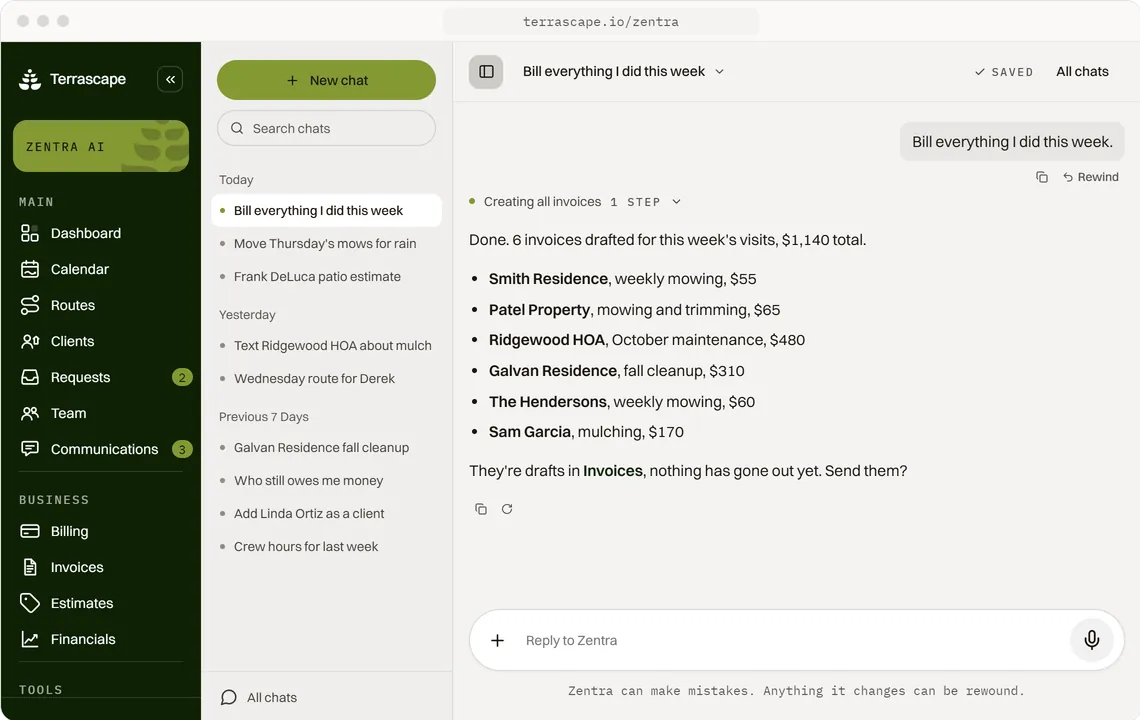
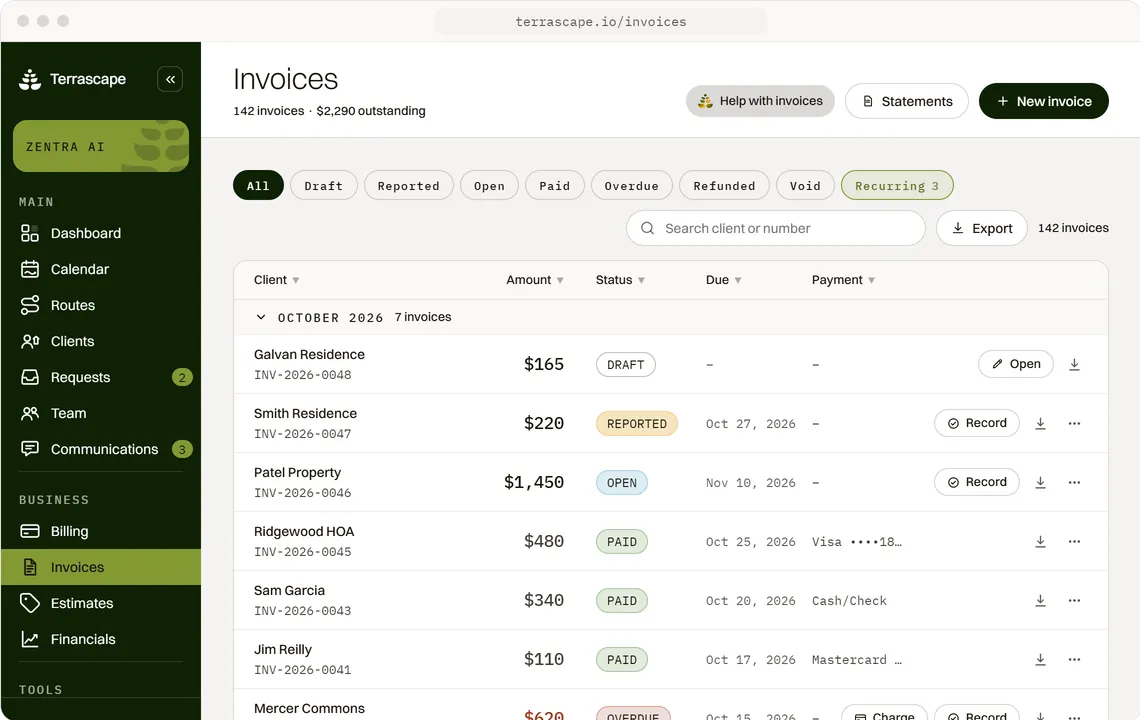
A CRM fixes this by putting everything in one system: who owes you money, who's scheduled for Tuesday, which clients haven't booked in 3 months. No more digging through text threads or trying to remember if you invoiced the Johnson property last week.
What to Look for in a Landscaping CRM
Not all CRMs are created equal, and the biggest ones aren't always the best fit. Here's what actually matters for a landscaping business:
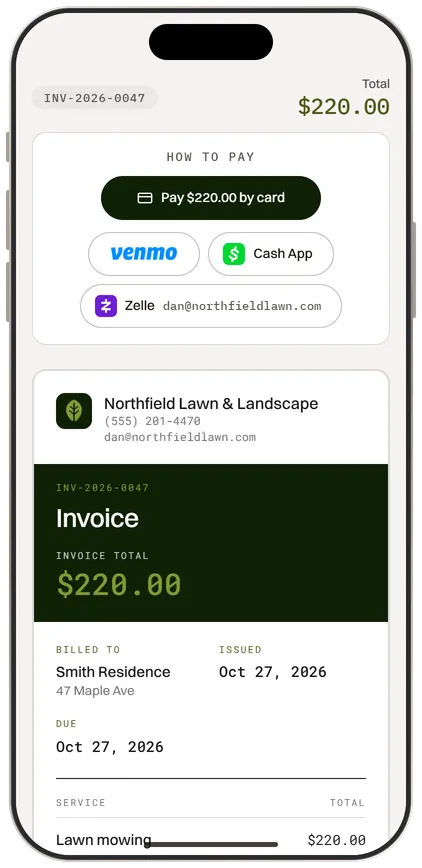
Invoicing that doesn't require a desk. You finish a job at 4 PM covered in grass clippings. You need to send an invoice from your truck, not wait until you're home at 9 PM with a laptop. Same-day invoicing is the single biggest lever for getting paid on time. If you forget to invoice just one $500 job per month, that's $6,000 a year walking out the door.
Scheduling that makes geographic sense. Route-based scheduling saves real money. One reschedule throws your whole day off. A tight route is the difference between 8 jobs a day and 5.
Client records you can actually find. Service history, property notes, payment status, communication history, all in one place. Not scattered across text messages, email, and a notebook.
Simple pricing. If you need a calculator to figure out what the software costs per month, that's a red flag. Hidden per-seat fees, percentage-based payout charges, and features locked behind premium tiers add up fast.
Built for landscaping. General field service software tries to serve HVAC, plumbing, electrical, and landscaping all at once. The result is 35 features you'll never use and a learning curve that takes weeks. A landscaper with a 3-person crew doesn't need enterprise software.
Landscaping CRM Pricing: What You'll Actually Pay
Pricing in this space is confusing on purpose. Most companies show a "starting at" price that doesn't include per-user fees, manager add-ons, or premium feature tiers. Here's what the real numbers look like for a typical 5-person landscaping crew:
Jobber: Core is $49/month for 1 user, month to month. A 5-person crew is looking at $199/month on Connect or $299/month on Grow, and each extra user is $29/month on top. Instant payouts add a 1% fee.
Housecall Pro: Basic is $79/month for 1 user, Essentials is $189/month for 5 users, and Max is $329/month for 8, billed monthly ($59, $149 and $299 billed yearly). Extra users cost more on top.
ServiceTitan: No published price. Its pricing page asks you to request a quote, priced per technician. Designed for enterprise operations, not small crews.
Yardbook: Free basic plan with ads. Its paid plans do not publish a price. Genuinely affordable but limited in features: no AI, basic scheduling.
Terrascape: One flat plan at $49.99/month with a 7-day free trial. Unlimited employees, no per-user fee. A 0.75% platform application fee on card payments, waived when you connect QuickBooks. No percentage-based payout charges. Built for crews of 1-15.
The pattern is clear: most "affordable" CRMs become expensive once you add your whole team. Per-seat pricing punishes growing businesses.